Tuesday, October 18, 2011

Pictures of Romania

We went to Transylvania this past weekend to visit our friends Dana and Brandi Bates (and Brianna and Gabriel!) at the New Horizons Foundation in Lupeni, Romania.  This is the view from our room in the Montana lodge in Straja..
This is the 10th (of twelve) station of the cross on the 5-mile road up to the top of Straja.
A beautiful sunny morning up in Straja.

With Dana Bates out at the Viata ropes course.
Julie grabbing the stick on the "leap of faith!"
Abi and Brianna had a good time together on Saturday.
The view from the New Horizons Foundation cabana.     
Headed down the mountain after a day on the ropes course.

Sunday, October 9, 2011

St. Columba's

A little bit about church in Budapest. We have been attending St. Columba's Scottish Presbyterian, a small, but old English-speaking congregation very near our apartment. In fact, it is about three tenths of a mile further in distance from our apartment than Neland Church, our home church, is from our house in Grand Rapids (.6 miles, and .9 miles respectively). There are several other options in the city, but for some reason, we have been drawn to this one. The worship is liturgical, but not high church. We sing from the Scottish hymnal, many songs of which are familiar to us. The people are exceedingly friendly, and incredibly internationally diverse. We have worshiped with brothers and sisters from Iraq, Jordan, Syria, Turkey, England (and Scotland, of course!), France, Macedonia, the US, Hungary, and many other countries. Each week after the service there is a meal to which all are invited. Members of the congregation offer to cook and set up and clean up. Today was an unbelievable meal prepared by a man who comes from Spain, and is a local chef. He put together a spread of empanadas, tacos, kebabs, and a huge platter of paella that was simply amazing - even just to look at, much less to have the privilege to eat. Another woman brought in three large bushels of apples, fresh-picked from her husband's orchards near Lake Balaton. Julie and I were in such awe that we volunteered our family for dish duty, and we gladly washed, dried and put away the dishes after such a feast. It was a love feast that reminded me of the way the earlier followers of Jesus would share so much together - the way things are supposed to be between people. It was a glimpse of a coming shalom.

The church has a history dating to the 1830s, when some Scottish missionaries landed in Budapest as the Chain Bridge was being built to connect the cities of Buda and Pest across the Danube River. The bridge was designed with a particular Scottish bridge in mind, and many Scots were put to work in its construction. So a church was born, with a dual mission to minister to these Scotsmen bridge workers, as well as to reach out to share the gospel with the large Hungarian Jewish population. See http://www.scotskirkhungary.com/?history for a more detailed version of the story. Another group of people working to make the gospel a reality right where they are. They have even provided for two of the service-learning placements for Calvin students that I was looking for; one is leading a small church choir for the fall term, and another is providing help with weekly English lessons.

We had the opportunity to visit at the pastor's home last week, at a monthly gathering they have at their apartment. It was a great chance to get to know their family better, and to enjoy a meal and good conversation with them and a few other members of the church.

Monday, October 3, 2011

It's a Small World at the Gulyás Party

First of all, what is gulyás?  You might call it goulash.  And what you call goulash might be nothing like what gulyás actually is.  Gulyás is a meat and vegetable soup or stew, seasoned with the ever-present Hungarian spice, paprika.

Next, a gulyás party?  Apparently, gulyás is traditionally cooked over an open fire all day.  The Calvin students (along with us Boumans) were invited by the family of 2011 Calvin graduate, Christian Gibson, to spend Saturday afternoon at their home in the Budapest suburb of Tőrőkbálint to enjoy their hospitality, learn a little bit about their work in Hungary, and eat gulyás.

The Gibson home was a lovely retreat, which is fitting, because they have just moved into it for their work in providing pastoral care and counseling to missionaries who may be experiencing crisis, burnout, or just the everyday stress that we all need help handling sometimes.  In addition to their own living space, they have a large apartment where missionaries can stay, meeting space, and lots of plans for ways they can use this space to minister.  Hungary is a great place for them to carry out this ministry because of its central location in Europe and the abundance of mission organizations headquartered here.  And as we experienced first-hand, their hospitality is generous and encouraging.

The table(s) are set, and the view is incredible.

But where does the small world element come into this party?  Well, the Gibsons had also invited some other people to gulyás with them, including a family whose daughter is looking at Calvin as a possible school choice.  When we were introduced to Kevin and Wendy Mason, Wendy asked what my last name is.  I told her, and she looked at me, still puzzling, and asked if I had by any chance gone to Grove City College.  Yes, unbelievably I found a long-lost college classmate in Hungary!  (Or more accurately, she had found me.)  We both graduated in 1989 with Elementary Education degrees.  Wendy is shown in the picture below, wearing a teal top and seated across the table from me. 


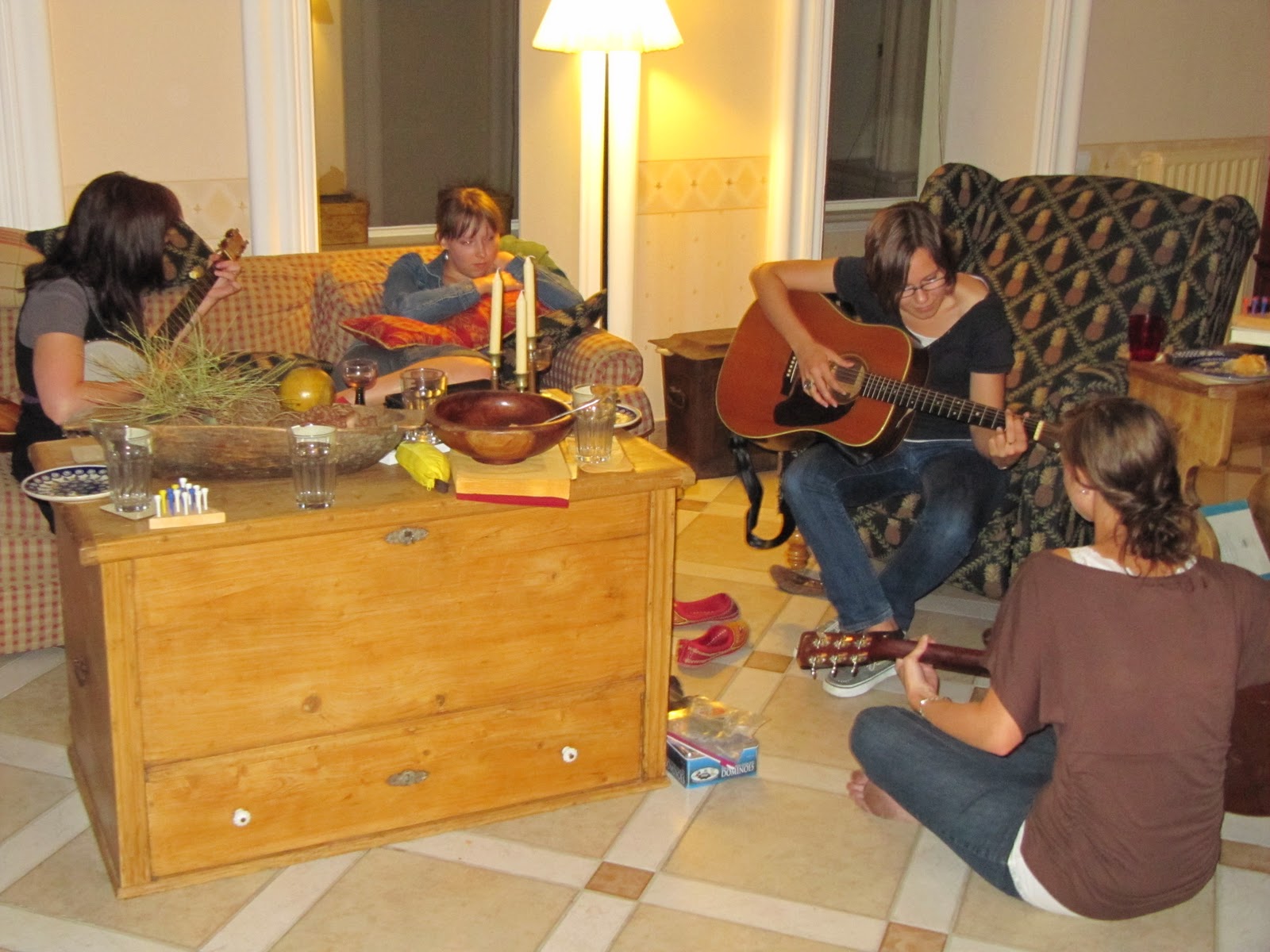
Students enjoying some of the Gibsons' many musical instruments

Many thanks to the Gibsons for a beautiful afternoon and evening of feasting, good company, and a little serendipity!

We enjoyed the Gibsons' hospitality on into the early evening.


Tuesday, September 27, 2011

A Favorite Hangout: Szent István tér


St. István tér is one of our favorite places to spend an evening.  Budapest is organized less by streets than by squares - intersections where major forms of transportation cross (yes cars, but also bus lines, metro stations, tram lines) or where there is green space or pedestrian areas.  St. István tér is where St. Stephen's Basilica is located, and the gorgeous basilica does dominate the square.  But there are lots of restaurants and cafes surrounding the square, tourists taking pictures, and people wandering through to stretch their legs, walk their dogs, meet a friend, or who knows why.

Monday, September 19, 2011

Reading Sarajevo in Grand Rapids, Seeing Sarajevo With My Own Eyes

I sent out a group email to my book club about spending the weekend in Sarajevo.  About a year ago, the Neland Book Club read The Cellist of Sarajevo, and I wanted to share with them seeing the setting of the book come to life.  A number of them responded right away, so either I hit a nerve or a bunch of book club members have too much time on their hands!

Actually, I know none of these women are sitting around with nothing to do, so I'm going to take their responses as affirmation that what I shared with them might interest you, too.

This past weekend our family accompanied the Calvin students on a visit to Sarajevo and Mostar (another city in Bosnia-Herzegovina).  Truly amazing. 

I saw first-hand so many of the scenes of action in the book.  I went to and ate at the brewery where the character Kenan went to get water for his family and his grouchy neighbor.  I saw the city hall/library that was burned down, and is still being restored bit by bit as money allows.  I saw the old marketplace that dates from the time of the Ottoman empire and the place where the city changes from the Ottoman empire to the buildings of the Austro-Hungarian empire, and then the still more recent Soviet era (not very interesting to see, though people still appreciate the jobs and industry of that time).  I saw the place where the people standing in line for the bread were killed.   And lest you think I remember all this from reading the book about a year for book club, let me hasten to add that I re-read the book while I was there.

This is not a place I ever would have thought, "Oh, Sarajevo - got to go there," but it is very beautiful, despite the tragedy it has suffered.  Though many scars of war remain, much has been rebuilt and it seems impossible to imagine the horrors that occurred there even though the evidence is in front of your eyes.  The people seem to be very resilient and tolerant. One of the most striking things we did was to climb partway up one of the hills of the city (just walking on streets) and watch the sunset, see the city lights come on and listen to the 7 pm call to prayer rise from the mosques all over the city.  It is something I never gave a thought to before, but despite our differences with the Muslim faith, there is something very beautiful about the call of the faithful to prayer all at the same time and in such a public way.

I miss the abundant, easy access to books in my own language and being able to share them with you, that I have at home.  But this is a truly amazing experience and I am very grateful.

 "The Seher Cehaja is the most eastern of the bridges crossing the Miljacka, and using it will require a significant detour, almost doubling the distance of his trip...The end of the bridge is just ahead, and his foot catches on a cleft in the pavement.  It seems like he's going to fall, but he doesn't, somehow, and he recovers himself enough to stumble across the rest of the bridge to the protection of a small building to his left."  When I read this, I imagined the bridge(s) as much longer than they actually are.
 The old Turkish neighborhood of Bascarsija - "For half a millennium, it has served as the city's marketplace, its streets organized according to the type of trades conducted there.  But in recent years this strict discipline had broken down a bit, with more and more shops selling merchandise designed for tourists."  This is the copper workers' street.

 Another view of Bascarsija
 "'There is a man playing the cello in the street,' she says. 'Near the market. Where the people were killed lining up for bread.'"
 "Arrow crosses and sits in the spot where the mortar landed, the spot where, later today, the cellist will sit.  She knows that twenty-two people died here and a multitude were injured, will not walk or see or touch again.  Because they tried to buy bread.  A small decision."
 The eternal flame commemorating the military and civilian victims of WWII in Saravejo.  Our tour guide, Berina, was a 9-year-old girl during the war in the 90s.  Her memories are of being in the basement all the time.
 The plaque on this building reads, "The first casualty when war comes is truth."
 "His head turns to the southwest, where, if keeps going past the bakery and then down through Mojmilo to Dobrinja, the not-so-secret tunnel leads under the airport into unoccupied territory."
 "He's almost at the Princip Bridge.  It used to be called the Latin Bridge, but it's there that, in 1914, the First World War began...He has always been slightly ashamed that, for a generation, when the world thought of Sarajevo, it was as a place of murder.  It isn't clear to him how the world will think of the city now that thousands have been murdered."  I know  about 22 people, at least,  who think of it as the haunting and unforgettable home of courageous and determined people.
 "The brewery has been badly damaged and parts of it are no longer safe, but its springs are deep beneath the surface, and the basement of the building is impenetrable even to the men on the hills, though that hasn't stopped them from trying to level the bright-red building.  The brewery is situation in a vulnerable position, only a short distance from the occupied hills."  It may have been badly damaged then, but it looks beautiful now.  If I were going to work in a factory, this would be the one.  And they make some very fine beer.
 The Miljacka River
 "It is all Kenan can do to look up at what remains of the National Library.  Though the stone and brick structure still stands, its insides are completely consumed.  The fire has left sooty licks above each window, and the domed glass ceiling that stood proud atop the building for a century has shattered to the floor...It was one of his favorite places in the city, though he wasn't a great reader.  It was the most visible manifestation of a society he was proud of."  And it will be again.  There are very ambitious plans to build it exactly as it was, and some of the work has already been done.
 Sunset over Sarajevo
City lights come on, and the call to prayer rises from every quarter of the city.

Saturday, September 10, 2011

Service-Learning in Budapest

I'll try to give a brief account of some of the amazing things I've seen and people I've met while criss-crossing the city over the past several weeks attempting to secure 18 places where the Calvin students can spend several of their student hours per week participating in the life of an existing organization in Budapest as a service-learner. Their learning will be both cultural and intellectual - they will be observing the lives of people who have chosen work that is very front-lines in terms of bringing positive social change to the world. I am excited after having nearly completed this challenge.

I have about half of the students placed in schools around Budapest. The range of these schools is tremendous. One is the Városligeti English-Hungarian Bi-Lingual Primary School, where two students will work with teachers who teach kids between kindergarten and the 8th grade in both English and Hungarian - they will bring lessons in art, singing, English, culture, and much more. The teachers seem excited to have native speakers as classroom helpers in a variety of subjects. Another school is the Baár-Madas Calvinist high school, a school with a fascinating history that includes a four-decade interruption in religious education when the Communist party "borrowed" the school for its purposes between 1945 and 1989. It is inspiring to walk the halls in this school and imagine what it took to bring it back on-line as a school that takes its Calvinist heritage seriously in its teaching and learning. Two students will work with one teacher here, assisting in the teaching of a variety of different lessons in English. Another is a school called the Alternative Secondary School of Economics, a middle and high school that practices a very open style of education, leaving much of the learning to the kids and their own direction. It is another old building, but beautifully renovated recently, with student art hanging on every wall, every ceiling - a very conducive atmosphere for learning. Two of our students will spend time here participating in a program called CircleSpeak, where the students come to an English-speaking after- and during-school club for the purpose of improving their English skills and learning about each other. And finally, a few students will be placed in schools where there are American teachers with the organization teachoverseas.com - here as English teaching staff with a mission to also share the gospel when possible. These are technical high schools geared to children, mostly boys, who have been tracked toward work in the trades and sciences.

Another half are split between organizations that have missions ranging from traditional church missions - outreach and evangelism, or care for refugees, or basic service provision. I have met excited Hungarians, Americans, Romanians, and others who are encouraged by the possibility of having an American college student with open eyes to the work of service that precedes their arrival in Budapest, and that will continue after they leave. Two will work with a coffee shop outreach operated by the Calvary Chapel Hungarian church community on a busy street in downtown Budapest; two will partner with the Scottish Presbyterian mission church in leading a choir and organizing a fund-raiser and teaching English; two will help an international service organization with its social networking and general organization; one will work with an organization that provides outreach to refugee children and works to bridge the gap between the Roma and non-Roma people in Budapest; and another will work with a recent church plant on behalf of the Hungarian Reformed Church in a district known for its diversity and edginess. And finally, one will work with Serve the City-Budapest, a fledgling organization created to organize and publicize service and outreach activities that make the larger city of Budapest just a little bit better.

And while the students spend these many hours in service, their minds and hearts will be at work as well as their hands and feet - we will be examining together the ways in which students have historically played a part in social change and activism; we will wonder with sociologist James Davison Hunter about the role of the Church in "changing the world" - whether this is an appropriate frame of reference or not. And we will seek the wisdom of our newly forming Hungarian friends and colleagues in our wonderings about these and other questions.

It has been a full and rich couple of weeks arranging these placements.

I haven't mentioned that the students, nearly all of them, spent a good part of today harvesting potatoes... This is a much longer story, I'm sure, but now that I've brought it up, a majority of our group, and Julie and Abi, took a weekend trip to Mukachevo, Ukraine, a 5 hour bus ride away, to visit Christian Reformed World Missions missionaries George and Sarah de Vuyst and their kids, and to participate in a fund-raising potato harvest for the work of the Timothy Leadership Institute in Ukraine. A much longer story, but the beginning of the Calvin-in-Hungary students' service-learning for the semester. To paraphrase Coach Taylor from Friday Night Lights, "Dirty hands, full hearts."

Sunday, September 4, 2011

Half a marathon

My legs still ache. Yesterday was the 26th annual running of the Budapest Half Marathon through the heart of Budapest, with more than half of the race running right along one side or the other of the Danube cutting through the heart of the city. One of our Calvin students, Ben Stark, and a visiting friend from Romania, Kadie Becker, and I all started together, running through City Park to Heroes' Square, and then down the famous Andrassy Boulevard to the Danube. We had set as our goal to stay near the balloon pace-setter leading a group to a 2-hour finish. After crossing the Chain Bridge and heading south down along the river, as we came to our first water stop (it was somewhere in the upper '80s, or around 32 degrees C), we became separated due to the jostling that happens when 7,000 people all reach for water cups at about the same time. Ok, there weren't 7,000 all in one place, but it seemed like it. Ben took off at that point, and we didn't see him again until the finish. He kept a good pace and finished in well under 2 hours at around 1:53. Kadie and I struggled a little more, with several places where we lost each other due to short walking breaks along the way. We were under an hour at the half-way point, but losing steam. It helped that there were so many people out to cheer, with around 10 places on the route set up with music and lots of excitement. I remember one sign in particular that some person along the route was holding out, it read simply, "you will make it to the finish line." This was a very helpful sign for me at about the 9 mile mark. With about 2 miles to go, I took an extended break, walking for about 5 minutes, with no idea where Kadie was, but with a fairly good idea that I would make it to the finish line before the 2.5 hour cut-off (they had to re-open the streets, so if you were not finished by 2.5 hours, they picked you up with a bus). Just as I reached my landmark where I had decided to start running again, I looked to my right, and there was Kadie, and we helped each other for the last mile as we re-entered Heroes' Square and the City Park for the final stretch. Along that stretch we saw Julie, Bastian and Abi, and several Calvin students who had come out to cheer us on - it was great. But I'm not going to lie, it was excruciating with each step. Not having trained for this distance, I only finished through the energy that came with that many people in that beautiful of a place, and when I was finished, I paid the price. As I said, I still ache, and probably will for awhile.

After crossing the finish line, it was great to find lots of folks there to greet us, and to help navigate the way to water, other refreshments, and other finishing details.

Thanks Kadie, Ben, Julie, Bass, Abbie, Joel, Kyle, Erica, Jen, Rebekah, Ainsley, Luke, others I don't remember, random person with the inspiring sign, and all 7,000 fellow runners
. It was a great time. Why did we do it? Maybe I should leave this question for the philosophers, but I would guess it has something to do with the human community, in addition to "because it was there."